 Estimated time: 6 minutes.
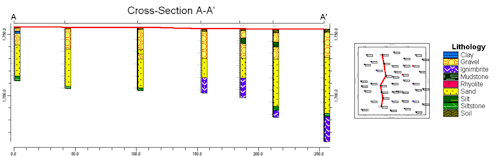
In this lesson, you will be creating an image representing the lithology data in multiple logs in the Samples project, selected along a multi-log cross section trace.
 Hang on Datum: Uncheck this.
 Annotation: Check this. These options determine text and lines that will plot around the perimeter of the profile. Click on this tab to view the options; the factory defaults should be fine. See Restore Default Settings if you need more information about setting the factory defaults.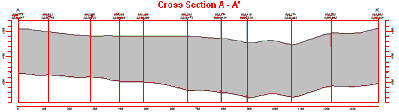
or Surface Profile: If you completed the borehole map section of the tutorial (jump back), insert a check in the Surface Profile option. This is used to display a selected surface in the cross section plot. If you DID NOT complete that lesson, leave this un-checked.
Infrastructure: Unchecked. Other 2D Files: Unchecked. Peripherals: Check this item and click on its tab.
Pattern Key: Check this peripheral item to include a legend in the diagram.
Lithology: Check this item. Uncheck the other legend options.
The program will display the 2D log designer window. This window has three main sections:
a. Choose the items you want to see in the logs by inserting a check-mark in the following items in the left pane:
Title: The drill hole name will plot above the logs. Depths: The logs will be labeled with depth tick marks and labels. Lithology: The logs will contain a column illustrating rock types with graphic patterns and colors.b. Adjust the arrangement of the visible log items: You should see four items in the upper Preview pane: title, depth bar, log axis, and lithology patterns.

! Note that the log axis is always activated. It acts as the anchor point for the log - it is the axis that will be placed at the actual log location in the diagrams. The log title is always placed atop the axis.
c. Check the options for each visible item by clicking on the item's name in the listing; its various settings will be displayed in the Options pane.
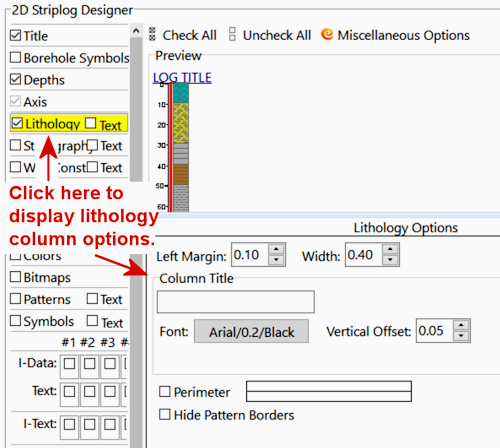
! All log item sizes are expressed as a percent of the dimensions of the project, so the width of these logs will be about 1% of the project dimensions.
Location Map: Find this tab to the right of the 2D Log Design tab. Check this item. This will create a small map that shows the location of the section in the study area. Click on this tab to change:
 Append Map to Diagram: Click in this radio button. Be sure the Size setting is set to Medium.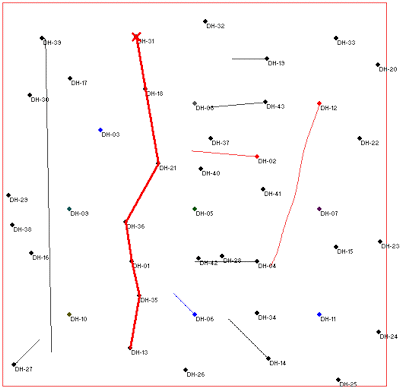
RockWorks will create strip logs of each of the selected borings using the selected settings. The logs will be spaced proportionally to their distance from each other on the ground.
In addition, it will create a map that displays the location of the section slice within the study area and append it to the cross section.
The completed log section will be displayed in a RockPlot2D tab in the Options window. RockPlot2D is where 2-dimensional maps, sections, and other diagrams are displayed.
 to fill the screen at whatever scales, or
See also: RockPlot2D tutorial
 Displaying Multiple Logs in a 2D Hole to Hole Section, Hole to Hole Sections versus Profile Sections
 Back to Lithology menu | Next (3D Lithology Model)
