
RockWorks | Utilities | EarthApps | Flyover | Simple: Camera Looking at Midpoint
This program:
- Reads a listing of XY locations from the Datasheet Editor. Typically this will be a circular or oval route so that the view focus remains toward the middle.
- Creates a KML output file containing the flyover along the listed route, using the elevation, timing, tilt, and smoothing that the user defines.
- Creates a KMZ (zip) output file, containing the KML file.
- Loads the KMZ file in Google Earth.
See also: Simple Flyovers - Forward Facing; Simple Flyovers from Space
Menu Options
Step-by-Step Summary
Menu Options
- Input Columns: The prompts along the left side of the window tell RockWorks which columns in the input datasheet contain what data. Click on an existing column name to select a different name from the drop-down list. See a sample data layout below.
- X: Column that contains the X coordinates for the flyover pathway.
These can be Eastings in meters or feet, decimal longitudes, etc. See Defining your Datasheet Coordinates for more information.
- Y: Column that contains the Y coordinates for the flyover path.
- Tour Title: Defines the flyover name.
- Time (Seconds) Between Points: Type in the number of seconds that should transpire between each pathway point. This establishes the pace of the flyover.
- Altitude (Meters - Relative to Ground): Enter here how high above the ground surface, in meters, that you want to "fly".
- Tilt: This defines the "camera" angle. Enter 0 for horizontal, -90 for straight down, or any value in-between. The view angle must be negative (looking downward).
- Pan Smoothing Factor: Enter here an integer value for smoothing the route. A flyover with smoothing of "3" will create much less camera-bounce around sharp corners than a flyover with smoothing of "0". Beware that high smoothing can cut tight corners.
Step-by-Step Summary
- Access the Utilities program tab.
- Create a new datasheet and enter or import your image names and locations into the datasheet.
Or, open one of the sample files and replace that data with your own. (In this example, the sample file = "RockWorks17 Data\EarthApps Samples\Flyover_Simple_Midpoint_01.rwDat")
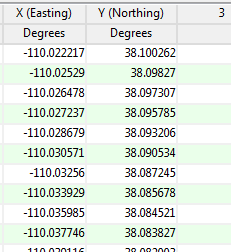
Longitude and latitude coordinates must be in decimal format. If you're using another coordinate system, be sure you've specified the Units and the Projection Settings as appropriate.
- Select the RockWorks | Utilities | EarthApps | Flyover | Simple: Camera Looking at Midpoint menu option.
- Enter the menu options as described above.
! Tip: If you're working with one of the sample .rwDat files, you can load its specific menu settings by (1) clicking on the Menu button at the top of the window, (2) clicking Load from RCL, and (3) browsing for the .rcl file with the same name as the .rwDat file you're working with.
- Click the Process button to continue.
The program will create a KML file listing the flyover path along the designated route. It will create a KMZ (zip) file containing the KML file. The Google Earth KML and KMZ file names will be assigned automatically.
- If RockWorks displays the KMZ name in a popup window for your reference, you can confirm:
- Automatically load file into Google Earth: Be sure this is checked if you want to display the output at this time.
- Show this message every time a KMZ File is Created: If checked, this window will be displayed each time a Google Earth output is created. Uncheck this if you prefer not to see this window in the future.
(Both of these settings are also available via the Preferences menu.)
- Click OK to continue or Cancel to cancel the operation.
The resulting flyover will be displayed in Google Earth, if requested.
 Back to Flyover Summary
"Google" is a trademark of Google Inc.

RockWare home page