RockWorks | Borehole Manager | Colors | Plan Map
Use this program to:
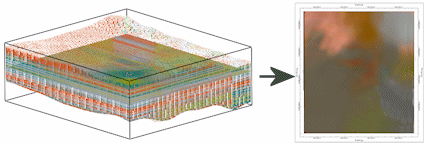
- Create a new 3-dimensional solid or block model representing your downhole color intervals (an .RwMod file) - OR - read an existing .RwMod file you've already created.
- Create a 2-dimensional map representing the colors where they intersect a horizontal plane.
In other words, it creates a color-based geological map based on downhole data. The color model stores the actual Windows color for each node. The completed map is displayed in RockPlot2D.
See also: Color Model Surface Maps for maps that intersect a grid-based surface.
Feature Level: RockWorks Standard and higher
Menu Options
Step-by-Step Summary
Tips
Menu Options
- Color Modeling Options: First, tell the program whether you wish to use an existing color solid model (from a previous use of this tool or another Colors menu tool) or you wish to create a new color solid model, by clicking in the appropriate radio button.
! NOTE This is not trivial. Creating the color model can take some time, depending on the resolution of the model and the detail of your data. If you already created a pleasing model for display as a profile, for example, you can use the same model, which was stored on disk as an .RwMod file, for the plan map.
- Create New Model: If want to create a new model, click in this radio button, and expand this item to establish the modeling settings.
- Create Filter / Sampling Report: If you select any filter/resampling options, this option will create a summary report of the results. (More.)
! Note that these tools filter the data that is passed to the modeling procedures. This is distinct from the filters that are applied after the model is completed (see Other Modeling Options below).
- Color Range Filter: Insert a check here to filter the input data based on color. (More.)
- Spatial (XYZ) Filtering: Insert a check in this box - on the far right side of the current program window - to activate a data filter based on spatial coordinates. Expand this heading to establish the filter settings.
- Solid Model Name: Click to the right to enter a name for the color model. The program will append automatically the file name extension .RwMod.
- Solid Modeling Options: Click on this button to establish important modeling settings:
- Algorithm (Modeling Method): This determines the modeling method to use, for creating a solid model from your irregularly-spaced drill hole color data. (More.)
- Model Dimensions: This determines the model density. (More.) Unless there's a specific reason to do otherwise, you should probably leave the solid model dimensions set to the current output dimensions.
- Other Modeling Options: These include tilting, warping, filtering above-ground, defining this as a color model type, and much more.
- Use Existing Model: If you wish to use an already-existing color model, click in this radio button, and expand this item to select:
- Model Name: Click to the right to browse for the name of the existing color model (.RwMod file) to be used for this profile.
- Output Grid: Click here to type in the name to assign the output grid (.RwGrd file) that will be created as a result of extracting a specific slice from the solid model. This grid model's nodes will be assigned the actual Windows color values interpolated for the data. (You'll choose the elevation level after setting up the menu options.)
- Diagram Settings:
- Background Image: Check this box to display a raster image behind the colors, and expand this heading to set the image options. (More.)
- Contour Lines: Check this box to represent color transitions using line contours. Expand this heading to access the contour options. (More.)
- Colored Intervals: Insert a check here to represent the model using color fills. Expand this heading to access the various options. (More.)
! Note: When creating a map representation of a color model, be sure to set the Color Scheme to "Direct" so that the actual model colors will be displayed.
- Labeled Cells: Check this to include a map layer that displays the solid model node values as labeled cells; expand the heading to adjust the layer's settings. Note that the color model nodes represent Windows colors, which can be very large integers. (More.)
- Borehole Locations: Insert a check in this box to display the borehole locations with map symbols, with a variety of labeling options. Expand this heading to access the symbol & label settings. (More.)
- Border: Check this to include a map border, and expand this heading to adjust the border options. (More.)
Step-by-Step Summary
Follow these steps to create a 2-dimensional map that displays the color zones that lie at a specific elevation:
- Access the RockWorks Borehole Manager program tab.
- Enter/import your data into the Borehole Manager. This tool specifically reads location, orientation (if any), and color data.
- Select the Colors | Plan Map menu option.
- Enter the requested menu items, described above
- Click the Process button to continue.
If you've selected Use Existing Model, the program will load the information from the existing color model (.RwMod file), and will proceed to diagram generation.
If you've selected Create New Model, the program will scan the project database and extract the XYZ points for all of the downhole color measurements. (For color data, the elevations will represent interval midpoints.) It will apply any source data filters you have requested.
- If you requested Confirm Dimensions, the program will first prompt you to confirm the default solid model dimensions. (More.)
- The program will then display a window listing all of the elevation levels in the solid model. Choose the elevation to be represented in the plan-view map, and click OK.
The program will use the selected algorithm to create a solid model of the downhole color data, storing the actual Windows color number as the "G" value in the model. The completed model will be stored on disk under the indicated file name.
The program will then read all of the voxels in the color model at the selected elevation, and store those colors in the output grid model. The program will then create the 2D color map using the requested diagram settings. The completed diagram will be displayed in a RockPlot2D tab in the Options window.
- You can adjust any of the modeling or diagram option in the pane to the left and then click the Process button again to regenerate the plan map.
! Each time you click the Process button, the existing map display will be replaced.
! * If the color model looks OK and you just need to adjust one of the diagram settings, you don't need to keep re-interpolating the model. Choose Use Existing Model and browse for the color .RwMod file to be used for the map. This can save you a lot of time.
- View / save / manipulate / print / export the image in the RockPlot2D window.
Tips:
- Double-click on the plan map in RockPlot2D to access the colorfill settings. There, you can adjust the minimum contour level, transparency, etc.
- Another way to view a horizontal slice within a solid model is via the Colors | Model option. Once the voxel block is displayed in RockPlot3D, access its Options window and insert a horizontal slice. This slice can be moved up/down interactively within the solid.
 Back to Colors Menu Summary

RockWare home page