RockWorks | Utilities | EarthApps | Lines | Polylines | Single
This program:
- Reads a listing of data from the Datasheet Editor: XY points and (optionally) Z elevations
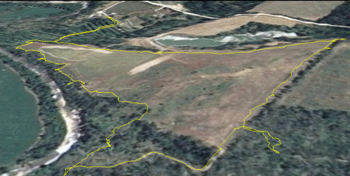
- Creates a KML output file with connected line segments drawn along these vertices using a fixed color. The polyline can be clamped to the ground, plotted at an elevation relative to the ground, or at an absolute elevation.
- Creates a KMZ (zip) output file, containing the KML file.
- Loads the KMZ file in Google Earth.
See also: Google Earth Polyline Maps - Multiple
Menu Options
Step-by-Step Summary
Menu Options
- Input Columns: The prompts along the left side of the window tell RockWorks which columns in the input datasheet contain what data.
Click on an existing name to select a different name from the drop-down list. See a sample data layout below.
- X: Column that contains the X coordinates for the polyline vertices.
These can be Eastings in meters or feet, decimal longitudes, etc. See Defining your Datasheet Coordinates for more information.
- Y: Column that contains the Y coordinates for the polyline vertices.
- Z: Column that contains the elevations for the vertices. These can either be absolute or relative elevations, as you define under Altitude Mode below. If the polyline is clamped to the ground, this column will be ignored.
These can represent meters or feet, kilometers or miles.
- Color: Defines the color for the polyline. The current color is displayed to the right. To change the color, click on the color sample and choose a new color from the drop-down list.
- Thickness (pixels): Defines the thickness for the polyline. Click on the displayed value to type in a preferred pixel thickness.
- Altitude: These settings determine the vertical placement of the polyline.
- Clamped to Ground: Choose this for the line segments to lie along the ground topography. Note that long segments will be subdivided automatically to hug the ground.
- User-Specified:
- Elevations
- Fixed: Choose this if all of the polyline vertices are to be plotted at the same elevation.
- Fixed Elevation (Meters): Click on the numeric value to the right to type in the desired elevation, in meters.
- Variable (Defined by Column): Choose this option if the elevations are listed in a column in the datasheet.
- Z Column: Defines the column containing the elevations for the polyline vertices.
Click on the current name ot the right, to choose a different column name from the drop-down list.
- Elevation Mode:
- Relative to Ground: Choose this if the fixed or variable elevations (above) represent distances above the ground. Note that short line segments will mirror the topography but long ones will not.
- Absolute: Choose this if the fixed or variable elevations (above) represent absolute elevations, regardless of the elevation of the ground surface at that location.
- Extrude: Check this option if you've selected above-ground display of the polyline (Relative or Absolute, above) and want to display the segments as extruded panels coming up from ground level, giving an appearance of a fence.
- Fill Color: Defines the color for the extruded panels. Click on the current color swatch to change the color. In the example below, the polyline is plotted in blue, at relative elevations, with the extruded panels filled red.

Step-by-Step Summary
- Access the Utilities program tab.
- Create a new datasheet and enter or import your location coordinates and other information into the datasheet.
Or, open one of the sample files and replace that data with your own. (In this example, the sample file = "RockWorks17 Data\EarthApps Samples\Polyline_Single_01.rwDat")
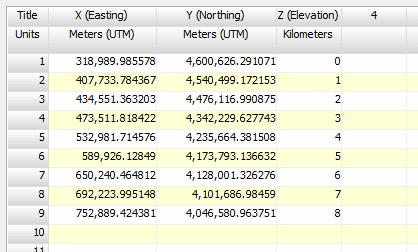
Longitude and latitude coordinates must be in decimal format. If you're using another coordinate system, be sure you've specified the Units and the Projection Settings as appropriate.
- Select the RockWorks | Utilities | EarthApps | Lines | Polylines | Single menu option.
- Enter the menu options as described above.
! Tip: If you're working with one of the sample .rwDat files, you can load its specific menu settings by (1) clicking on the Menu button at the top of the window, (2) clicking Load from RCL, and (3) browsing for the .rcl file with the same name as the .rwDat file you're working with.
- Click the Process button to continue.
The program will create a KML file with line segments between the coordinate pairs, in the color, thickness, and elevation mode you specified. It will create a KMZ (zip) file containing the KML file. The Google Earth KML and KMZ file names will be assigned automatically.
- If RockWorks displays the KMZ name in a popup window for your reference, you can confirm:
- Automatically load file into Google Earth: Be sure this is checked if you want to display the output at this time.
- Show this message every time a KMZ File is Created: If checked, this window will be displayed each time a Google Earth output is created. Uncheck this if you prefer not to see this window in the future.
(Both of these settings are also available via the Preferences menu.)
- Click OK to continue or Cancel to cancel the operation.
The resulting map will be displayed in Google Earth, if requested.
 Back to Line Maps Summary
"Google" is a trademark of Google Inc.

RockWare home page