RockWorks | Utilities | EarthApps | Images | Drape | Time-Based Animation
This program:
- Reads a listing of data from the Datasheet Editor: image file names and start/end dates.
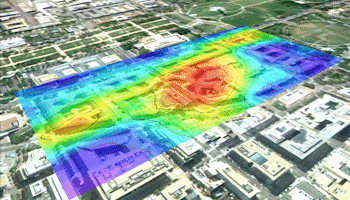
- Creates a KML output file listing all of the images at a specific location (defined by longitude and latitude coordinates), draped over the ground surface.
- Creates a KMZ (zip) output file, containing the KML and the image files.
- Loads the KMZ file in Google Earth. This will be an "animation" file which can be played within Google Earth.
! This tool assumes that all of the images occupy the same spatial area.
See also: Draped Image Maps using Midpoints, Draped Image Maps using 2 Corner Points,
Menu Options
Step-by-Step Summary
Menu Options
- Input Columns: The prompts along the left side of the window tell RockWorks which columns in the input datasheet contain the required data.
Click on an existing column name to select a different name from the drop-down list. See a sample data layout below.
- Name: Select the column that contains the text to label the image in the Google Earth side panel. If you don't have a separate name or title column, you can just set this to the Image File column.
- Image File: Select the column that contains the names of the images to be displayed in Google Earth. This program supports .BMP, .JPG, .PNG, .GIF, .TGA, and .TIF images.
Tip: use the File | Import | Create File List program to quickly create a list of specified file names.
- Start Date: Column that contains the starting date for the image. (Note that RockWorks will assume you are entering the dates in a format consistent with the date format established in Windows; 12/30/2012 in the US and 30/12/2012 in Europe, for example.)
- End Date: Column that contains the ending date for the image.
- Area of Interest: These settings define where the images will be plotted.
- Longitude:
- Minimum (Western Border): Type into this prompt the longitude coordinate for the western border for all of the images.
- Maximum (Eastern Border): Type into this prompt the longitude coordinate for the eastern border for all of the images.
! Western longitudes must be negative.
! Coordinates must be in a decimal format (e.g. -77.034454)
- Latitude:
- Minimum (Southern Border): Type in the latitude coordinate for the southern edge for all of the images.
- Maximum (Northern Border): Type in the latitude for the northing edge of all of the images.
! Southern latitudes must be negative.
! Coordinates must be in a decimal format (e.g. 38.891579)
- Image Opacity: Use this setting to adjust the transparency of the images, with 0 = fully transparent and 100 = fully opaque.
Step-by-Step Summary
- Access the Utilities program tab.
- Create a new datasheet and enter or import your image names and dates into the datasheet.
Or, open one of the sample files and replace that data with your own. (In this example, the sample file = "RockWorks17 Data\EarthApps Samples\Drape_Time_01.rwDat")

- Select the RockWorks | Utilities | EarthApps | Images | Drape | Time-Based Animation menu option.
- Enter the menu options as described above.
! Tip: If you're working with one of the sample .rwDat files, you can load its specific menu settings by (1) clicking on the Menu button at the top of the window, (2) clicking Load from RCL, and (3) browsing for the .rcl file with the same name as the .rwDat file you're working with.
- Click the Process button to continue.
The program will create a KML file listing the animation and referencing the raster images at the defined locations. It will create a KMZ (zip) file containing the KML file and the image files. The Google Earth KML and KMZ file names will be assigned automatically.
- If RockWorks displays the KMZ name in a popup window for your reference, you can confirm:
- Automatically load file into Google Earth: Be sure this is checked if you want to display the output at this time.
- Show this message every time a KMZ File is Created: If checked, this window will be displayed each time a Google Earth output is created. Uncheck this if you prefer not to see this window in the future.
(Both of these settings are also available via the Preferences menu.)
- Click OK to continue or Cancel to cancel the operation.
The resulting animation will be displayed in Google Earth, if requested. You'll see the Google Earth Time-Slider at the top of the display - use these controls to run the animation.
 Back to Image Maps Summary
"Google" is a trademark of Google Inc.

RockWare home page